
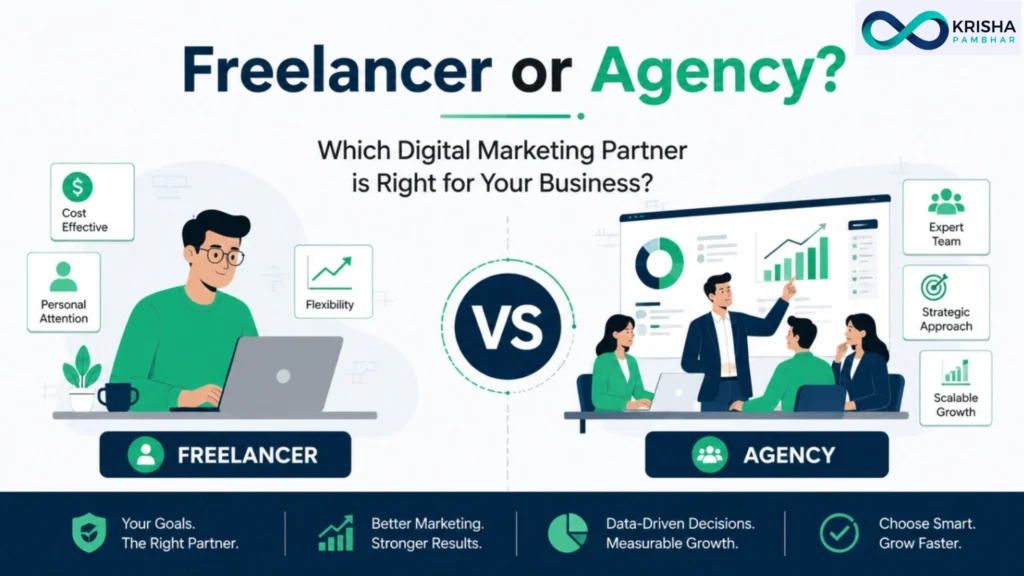
Digital Marketing Freelancer vs Agency: Which Wins? The answer depends on your business goals, budget, and growth stage rather than which option appears more professional. Choosing between a digital marketing freelancer and a digital marketing agency is one of the most important decisions a business owner makes before scaling online. The right marketing partner should align with your current needs, available resources, and long-term objectives to help you achieve sustainable business growth.
Should You Hire a Digital Marketing Freelancer or a Digital Marketing Agency?
A digital marketing freelancer is best if you need affordable, flexible, one-on-one support for a specific task like SEO or social media. A digital marketing agency is best if you need a full team, multiple services, and structured processes to scale faster. The right pick depends on your budget, workload, and growth goals.
Many businesses make this decision emotionally — going with whoever they spoke to first — instead of matching the hire to the actual scope of work. A single freelancer, however talented, has limited hours in a day. If your business needs SEO, paid ads, content, and email marketing running simultaneously, one person will struggle to give each channel full attention. An agency solves this with specialists per channel, but at a higher monthly cost. As a rule of thumb: if you need one skill done well, a freelancer usually wins on value. If you need multiple channels working together toward one strategy, an agency’s coordinated team structure tends to produce more consistent results.
Which Is Better for Small Businesses, Startups, and Growing Brands?
Small businesses and early-stage startups typically get better value from freelancers due to lower costs and direct communication, while growing brands with bigger budgets benefit more from agencies that offer strategy, scale, and accountability across multiple marketing channels at once.
A small local business testing its first Instagram ad campaign rarely needs a 10-person agency team — a skilled freelancer can set up, run, and optimize that campaign at a fraction of the cost. Startups in their first 12–18 months often operate this way, hiring freelancers for specific, well-defined tasks while cash flow is tight. As revenue grows and marketing needs multiply — SEO, paid media, email, content, and analytics all running together — coordination becomes harder for one person to manage alone. This is typically when growing brands transition to an agency, or hire a digital marketing consultant to bridge the gap. There’s no universal “better” option here; it’s a question of matching the marketing partner’s capacity to your business’s current stage and complexity, then reassessing every 6–12 months as needs shift.
Digital Marketing Freelancer vs Digital Marketing Agency: Complete Guide
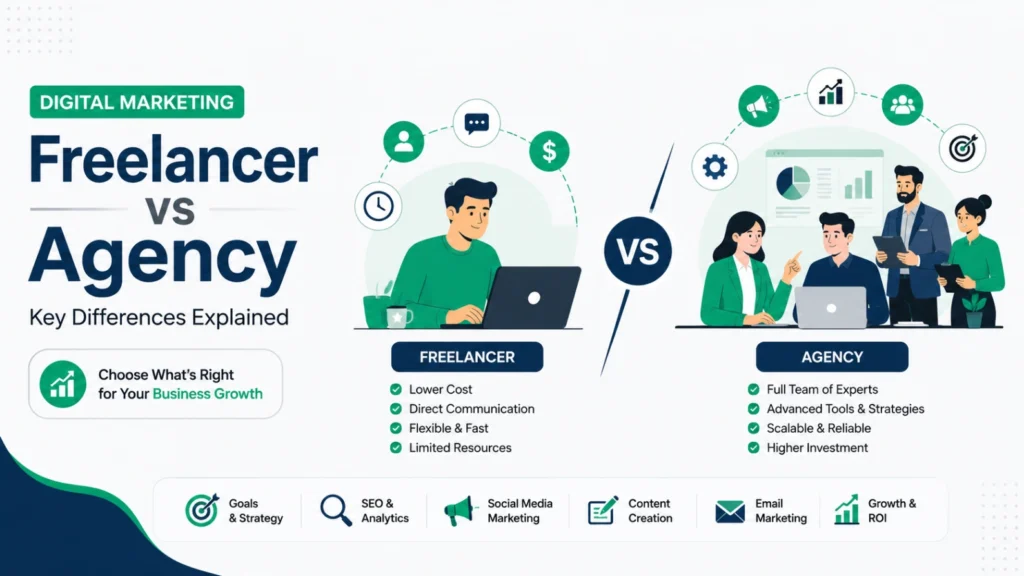
This guide breaks down the practical differences between hiring a digital marketing freelancer and a digital marketing agency, covering cost, services, accountability, scalability, and communication — so you can make a decision based on facts rather than assumptions or sales pitches.
Most comparisons online focus only on price, which misses half the picture. Cost matters, but so does reliability, skill depth, and how well the partner fits your internal team’s workflow. A freelancer might charge $500–$2,000 a month depending on scope and experience, while a small-to-mid agency retainer often starts around $1,500–$5,000+ per month for multi-channel management. Beyond pricing, consider response time, backup coverage during illness or vacation, reporting cadence, and contract flexibility. This guide walks through each of these factors individually — services offered, pros and cons of each model, red flags to watch for, and a framework for making the final call — so that by the end, you’ll know exactly which option lines up with your business goals, not just your budget.
Quick Comparison Table: Freelancer vs Agency
Factor | Digital Marketing Freelancer | Digital Marketing Agency |
Cost | Generally lower, pay-per-project or hourly | Higher, usually monthly retainer |
Team size | One person handling everything | Multiple specialists per channel |
Turnaround | Faster on small tasks | Structured but sometimes slower |
Scalability | Limited by one person’s time | Easier to scale services up |
Communication | Direct, one point of contact | Account manager + team |
Backup coverage | Limited if freelancer is unavailable | Team-based redundancy |
Best for | Single-channel needs, tight budgets | Multi-channel, larger campaigns |
Contracts | Often flexible, short-term | Often longer-term retainers |
Use this table as a quick filter, then read the sections below for the reasoning behind each row before signing any contract.
How We Compared Freelancers and Digital Marketing Agencies
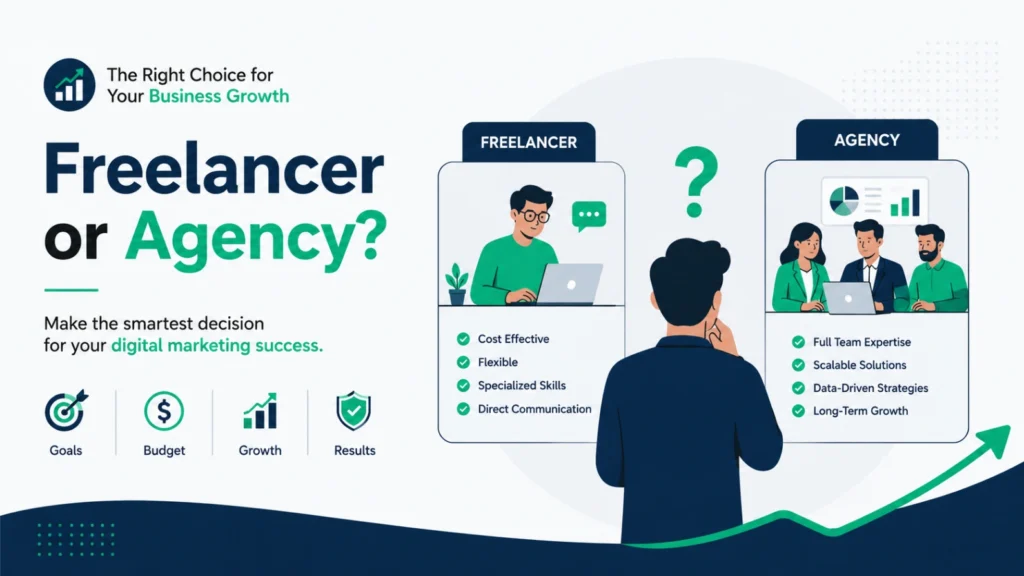
This comparison is based on common industry pricing structures, service delivery models, and patterns observed across small business and startup marketing engagements, rather than a single case study — giving a realistic, balanced view of what businesses can actually expect from each option.
To keep this guide practical rather than theoretical, the comparison weighs five factors that consistently affect real-world outcomes: cost per deliverable, speed of execution, depth of expertise per channel, accountability structures, and flexibility of engagement terms. Freelancer platforms, agency case studies, and typical service-level agreements (SLAs) were reviewed to identify patterns rather than outliers. It’s worth noting that quality varies widely within both categories — a poorly vetted agency can underperform a skilled freelancer, and vice versa. That’s why this guide emphasizes evaluation criteria (covered later, under red flags and how to choose) rather than declaring one option universally superior. The goal is to help you apply this framework to your own budget and goals, not to hand you a one-size-fits-all verdict.
Digital Marketing Freelancer vs Agency: Key Differences Explained
The core differences between a freelancer and an agency come down to team size, service breadth, pricing structure, and accountability. Freelancers offer personalized, lower-cost service from one skilled individual, while agencies provide broader, team-based support with greater structure, oversight, and capacity for larger campaigns. Understanding the benefits of hiring digital marketing services can help businesses choose the right option based on their goals, whether they need specialized expertise for a single channel or a full-service strategy to drive long-term growth, improve online visibility, and maximize marketing ROI.
Beyond the basics, a few nuanced differences matter in practice. First, specialization: a freelancer is often a generalist or a niche expert in one channel (say, SEO or Meta Ads), while agencies typically employ dedicated specialists for each channel under one roof. Second, tools and reporting: agencies usually invest in premium analytics, project management, and reporting software that individual freelancers may not have budget for. Third, risk distribution: with a freelancer, your entire campaign depends on one person’s availability and consistency; with an agency, work is distributed across a team, reducing the impact if one team member is unavailable. Fourth, strategic depth: agencies often bring cross-channel strategy experience from managing many clients simultaneously, while freelancers may offer deeper, more hands-on focus on your account specifically since they typically manage fewer clients at once.

What Does a Digital Marketing Freelancer Do?
A digital marketing freelancer is a self-employed professional who offers marketing services — such as SEO, social media management, paid ads, content writing, or email marketing — directly to businesses, usually working independently on a project, hourly, or retainer basis without the overhead of an agency.
Understanding what is freelancing and how does it work helps clarify this role: freelancing means working independently for multiple clients rather than being employed full-time by one company. A digital marketing freelancer typically specializes in one or two core skills rather than offering every service under the sun. For example, a freelancer might focus exclusively on Google Ads management, or on writing SEO-optimized blog content. Daily work often includes campaign setup, keyword research, content creation, performance tracking, and client communication — all handled personally rather than delegated to a team. Because freelancers manage fewer clients simultaneously than agencies, they can often provide more direct attention and faster turnaround on smaller tasks. However, availability can be a constraint; if a freelancer is sick, on vacation, or overbooked, there’s typically no backup team member to step in, which is an important trade-off to weigh against the cost savings.
What Is a Digital Marketing Agency?
A digital marketing agency is a company that employs a team of specialists to manage multiple marketing services — including SEO, paid advertising, social media, content, and analytics — for clients, offering structured processes, account management, and the capacity to run larger, multi-channel campaigns.
What is a digital advertising agency in practice? It’s essentially a business built around delivering marketing services at scale, with defined roles: strategists, ad specialists, content creators, designers, and account managers who each contribute to a client’s campaign. This structure allows agencies to handle complex projects — like a full website relaunch paired with a paid ad campaign and ongoing SEO — that would overwhelm a single freelancer. Agencies typically operate on monthly retainers, with reporting dashboards and regular strategy calls built into the engagement. The trade-off is cost: you’re paying not just for the marketing work itself, but for the coordination, tools, and overhead that come with a full team. For businesses with multiple simultaneous marketing needs, this structure often produces more consistent, scalable results than juggling several freelancers independently — though vetting the agency’s actual track record still matters more than its size.
Services Offered by Digital Marketing Freelancers vs Agencies
Freelancers typically offer focused, single-channel services like SEO, content writing, or social media management, while agencies offer bundled, multi-channel services including SEO, PPC, social media, email marketing, web design, and analytics — managed together under one coordinated strategy.
Service | Freelancer | Agency |
SEO | Often a specialty | Usually included |
Paid ads (PPC) | Sometimes offered | Usually included |
Social media management | Common specialty | Usually included |
Content writing | Common specialty | Usually included |
Email marketing | Less common | Often included |
Web design/development | Rare, unless specialized | Often included |
Analytics & reporting | Basic reporting | Advanced dashboards |
Digital marketing consultation services | Sometimes offered | Frequently offered |
If your business only needs one service done well, a freelancer specializing in that exact skill is often more cost-effective than paying for a bundled agency package you won’t fully use.
Pros and Cons of Hiring a Digital Marketing Freelancer
Hiring a digital marketing freelancer offers lower costs, direct communication, and flexible contracts, but comes with limited capacity, single points of failure, and fewer resources for large, multi-channel campaigns compared to an agency team.
Pros: Lower cost per project or hour; direct, one-on-one communication without layers of account management; flexible, often short-term contracts that are easy to adjust; and personalized attention since freelancers usually manage fewer clients. Many freelancers also bring specialized, deep expertise in a single channel, which can outperform a generalist agency team member on that specific skill.
Cons: Limited availability — no backup if the freelancer is sick, on vacation, or overwhelmed with other clients. Capacity constraints mean scaling up quickly (e.g., launching in three new channels at once) can be difficult. There’s also more due diligence required on your end, since freelancers vary widely in skill and reliability, and fewer built-in accountability structures compared to an agency’s internal quality checks. For businesses considering this route, it helps to learn more about vetting freelance talent before committing to a long-term contract.
Pros and Cons of Hiring a Digital Marketing Agency
Hiring a digital marketing agency provides access to a full team, structured reporting, and scalability across multiple channels, but typically costs more, may involve less personalized attention, and can come with longer contract commitments than working with a freelancer.
Pros: Access to a full team of specialists rather than one generalist; capacity to run several channels simultaneously with coordinated strategy; built-in redundancy if one team member is unavailable; and typically more robust reporting tools, project management systems, and quality-control processes. Agencies also tend to have broader experience managing budgets across many clients and industries, which can translate into stronger strategic guidance.
Cons: Higher monthly cost, often requiring a minimum retainer that may not fit smaller budgets. Communication sometimes flows through an account manager rather than the specialist actually doing the work, which can slow down feedback loops. Some agencies also lock clients into longer contracts, and quality can vary significantly depending on which team members are actually assigned to your account — a factor worth clarifying before signing.
Freelancer vs Agency: Which Option Fits Your Business Goals?
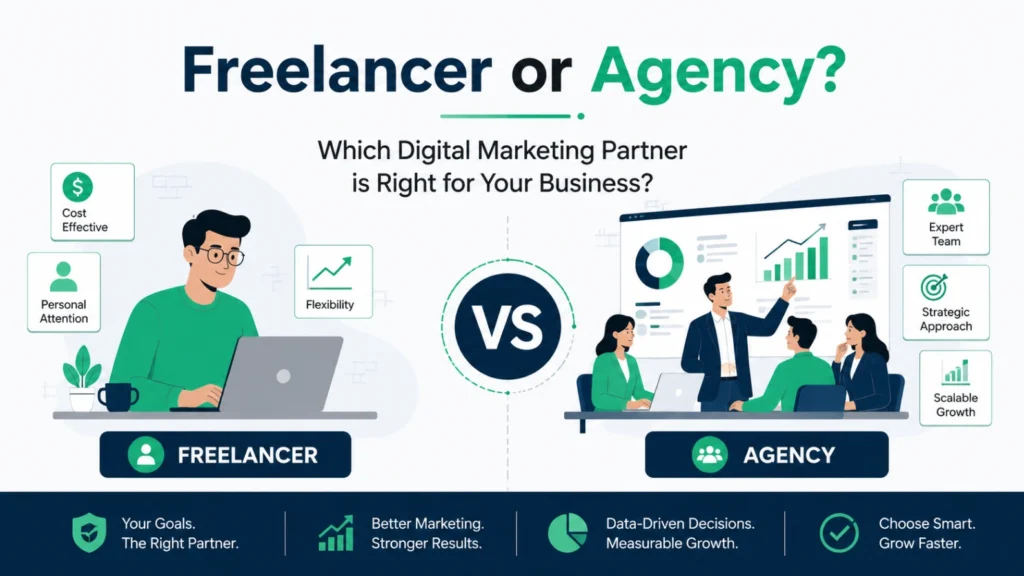
The right choice depends on your goals: freelancers fit businesses needing one skill executed well on a limited budget, while agencies fit businesses pursuing multi-channel growth, needing structured accountability, and ready to invest more for scale and coordinated strategy across marketing channels.
Think in terms of specific scenarios. If your goal is simply “get our blog ranking on Google,” a freelance SEO specialist focused entirely on that outcome is often the most efficient choice. If your goal is “launch our brand across five channels and build a consistent identity everywhere,” an agency’s coordinated team is better equipped to keep messaging, creative, and timing aligned. Businesses preparing for a product launch, a funding round, or rapid scaling often lean toward agencies because the stakes of disjointed execution are higher. On the other hand, businesses testing a new market, validating an idea, or operating on a lean budget often start with freelancers and graduate to an agency later. Some businesses also use a hybrid model — a digital marketing consultant to set strategy, paired with freelancers to execute specific tasks — which can offer a middle ground between cost and coordination.
Common Misconceptions About Hiring Freelancers and Agencies
A common misconception is that agencies always deliver better results than freelancers, or that freelancers are always cheaper and less reliable. In reality, quality depends on the individual or team’s skill and experience — not simply on whether they operate as a freelancer or an agency.
Another widespread myth is that freelancers can’t handle “serious” or large-scale campaigns — many experienced freelancers manage six-figure ad budgets competently, sometimes with subcontracted support of their own. Conversely, some assume agencies always provide senior-level attention, when in practice, junior staff often handle day-to-day execution while senior strategists oversee multiple accounts at once. There’s also a misconception that price directly correlates with quality in either category — an expensive agency retainer doesn’t guarantee better results than a well-vetted freelancer, and a cheap freelancer isn’t automatically a bargain if the work requires revision. The safest approach is judging based on portfolio, references, communication style, and a trial project — not the business structure alone.
How to Choose the Right Digital Marketing Partner
Choosing the right digital marketing partner starts with defining your goals, budget, and required services, then evaluating candidates based on relevant experience, communication style, reporting transparency, and references — rather than choosing based on price alone or which option seems more established.
Start by writing down exactly what you need: one channel or several, ongoing management or a one-time project, and your realistic monthly budget. Next, request case studies or references relevant to your industry — a freelancer or agency that’s driven results for a similar business type is a stronger signal than generic testimonials. During initial conversations, pay attention to how clearly they explain their strategy; vague answers about “boosting engagement” without specifics are a warning sign. Ask about reporting frequency and what metrics they’ll track against your actual business goals, not just vanity metrics like likes or impressions. Many businesses find it useful to start with a smaller trial project before committing to a long-term retainer — this lets you evaluate real working quality with limited risk before scaling the relationship.
Red Flags to Avoid When Hiring a Freelancer or Agency
Key red flags include vague deliverables, no clear reporting process, guaranteed rankings or results, pressure to sign long contracts immediately, and an unwillingness to share references or past work — all signs that suggest limited experience or accountability.
Be especially cautious of anyone who guarantees specific outcomes like “#1 ranking on Google” or a fixed number of viral posts — no ethical marketer can promise exact results because platform algorithms are outside anyone’s full control. Similarly, watch for unclear pricing structures, where scope keeps expanding without corresponding cost adjustments, or reporting that shows only surface-level metrics (likes, followers) instead of business outcomes (leads, sales, conversions). Poor communication early on — slow replies, unclear answers, or reluctance to explain their process — usually predicts the same pattern once you’re a paying client. For agencies specifically, ask directly who will be working on your account day-to-day, since some outsource execution without disclosing it upfront. For freelancers, ask about their backup plan if they’re unavailable during a critical campaign period. Trusting your instincts during these early conversations often prevents costly mismatches later.
Why Your Choice Can Impact Marketing ROI and Business Growth
The freelancer-versus-agency decision directly affects marketing ROI because mismatched capacity, expertise, or communication can waste budget on underperforming campaigns, while the right fit accelerates growth through faster execution, better targeting, and consistent, data-driven optimization over time.
Consider two scenarios: a startup hires an expensive agency for a task a single freelancer could have handled just as well — wasting budget that could have funded product development or ad spend instead. Alternatively, a growing business relies on one overstretched freelancer to manage five channels simultaneously, resulting in inconsistent posting, missed optimization opportunities, and underperforming campaigns compared to what a coordinated team could achieve. Both mismatches quietly erode ROI over months, even when the individual work itself isn’t “bad.” One of the most reliable industry practices is reviewing marketing partner performance quarterly against agreed KPIs, adjusting the working relationship (or the partner) if results consistently fall short. Treating this decision as ongoing — not a one-time choice — is one of the clearest ways businesses protect their marketing budget and compound growth over time rather than restarting from scratch with each new hire.
Future of Digital Marketing Freelancers and Agencies in 2027
By 2027, the line between freelancers and agencies is expected to blur further, with more freelancers forming flexible collectives to offer multi-channel services, and more agencies adopting leaner, specialist-driven models — giving businesses more hybrid options between the traditional two extremes.
AI-assisted tools are already reducing the time needed for tasks like content drafting, ad copy variations, and basic reporting, allowing skilled freelancers to take on larger scopes of work than before without needing a full traditional team. At the same time, agencies are increasingly restructuring around smaller, specialized “pod” teams rather than large generalist departments, partly to stay competitive with freelancer pricing. Expect to see more freelance collectives and boutique agencies occupying the middle ground — offering team-based coordination with freelancer-level flexibility and cost. For businesses, this means the freelancer-vs-agency decision may become less binary over time, with the real differentiator shifting toward proven results, transparent communication, and adaptability, rather than which business structure a marketing partner operates under. Staying informed on these shifts helps businesses negotiate better terms and avoid overpaying for outdated service models.
Conclusion
There’s no universally “better” option between a digital marketing freelancer and a digital marketing agency — only the option that better fits your current budget, goals, and complexity of needs. Early-stage businesses with a single, well-defined marketing task often get strong value from a skilled freelancer, while growing businesses juggling multiple channels typically benefit from an agency’s coordinated team and structured accountability.
The smartest approach is to revisit this decision periodically rather than treating it as permanent. As your business evolves — new products, bigger budgets, more channels — your ideal marketing partner may shift from a freelancer to an agency, or vice versa. Whichever path you choose, prioritize proven experience, clear communication, transparent reporting, and references over price or business structure alone. Whether you start with a freelancer, a digital marketing consultant, or a full agency team, the goal remains the same: consistent, measurable progress toward your actual business objectives, not just activity on social media or a busy-looking marketing calendar.

Frequently Asked Questions (FAQs)
A digital marketing freelancer is an independent professional who usually specializes in one or more marketing services. A digital marketing agency is a team of experts offering a wider range of services such as SEO, PPC, social media marketing, content marketing, and web development. Freelancers are often more affordable, while agencies provide broader expertise and scalability.
A freelancer is often a better choice for small businesses with limited budgets and simple marketing needs. A digital marketing agency is more suitable for businesses that need multiple marketing services, larger campaigns, or a dedicated team to manage ongoing growth.
Yes. In most cases, hiring a digital marketing freelancer is more affordable because freelancers have lower operating costs than agencies. However, agencies may provide better value if you require multiple services or long-term marketing support.
You should hire a digital marketing agency when your business requires a complete digital marketing strategy, multiple specialists, faster project delivery, advanced tools, or ongoing campaign management across different marketing channels.
Yes, an experienced digital marketing freelancer can deliver excellent results, especially for specific services like SEO, content marketing, or social media management. However, agencies usually perform better for large-scale projects that require expertise from multiple specialists.
Before making a decision, consider your budget, business goals, required services, project complexity, industry experience, client reviews, communication, and long-term growth plans. Choosing the right marketing partner depends on your specific business needs.
Choose a digital marketing partner by reviewing their experience, portfolio, case studies, client testimonials, service offerings, pricing, communication process, and proven results. Select the option that best matches your business objectives, budget, and future growth plans.