
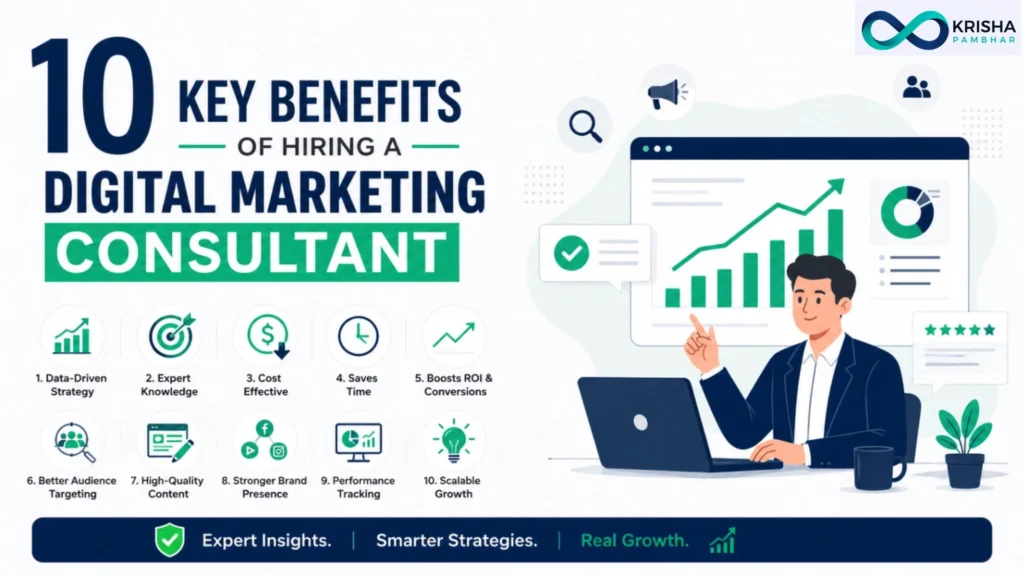
Top 10 Benefits of Hiring a Digital Marketing Consultant In 2027 is the ultimate resource for businesses looking to improve their online presence and achieve long-term growth. As digital competition continues to increase in 2027, hiring a digital marketing consultant can help you create effective marketing strategies, optimise your campaigns, and maximise your return on investment. In this guide, you’ll discover the Top 10 Benefits of Hiring a Digital Marketing Consultant In 2027 and learn why working with an experienced expert can give your business a competitive advantage.
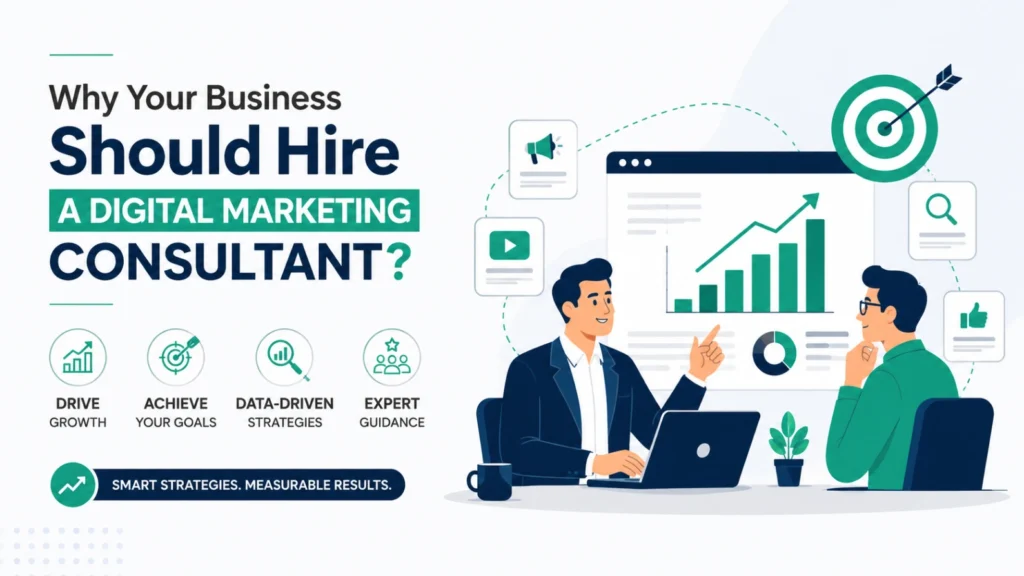
Why Should Businesses Hire a Digital Marketing Consultant?
A digital marketing consultant helps businesses grow faster by building data-backed strategies, fixing weak marketing spend, and bringing specialized skills that most in-house teams don’t have. Instead of guessing what works, businesses get expert direction across SEO, paid ads, content, and social media — saving time, money, and costly trial-and-error.
Most small and mid-sized businesses don’t have the budget to hire a full internal marketing department with a strategist, SEO expert, ad specialist, and analyst all at once. A digital marketing consultant fills that gap by acting as a fractional expert — someone who has already tested strategies across multiple industries and knows what converts and what wastes budget. For example, a local retail brand struggling with low website traffic may only need a short consulting engagement to identify that their Google Business Profile is incomplete and their ad targeting is too broad — issues an experienced consultant can spot within days.
This is also why searches for digital marketing consultation services have grown steadily — businesses want expert insight without the overhead of a full agency retainer or in-house hire. A consultant offers flexibility: strategic guidance, hands-on execution, or a mix of both, depending on business needs. This makes hiring a consultant one of the most practical growth decisions a business can make today.
Is Hiring a Digital Marketing Consultant Worth It in 2027?
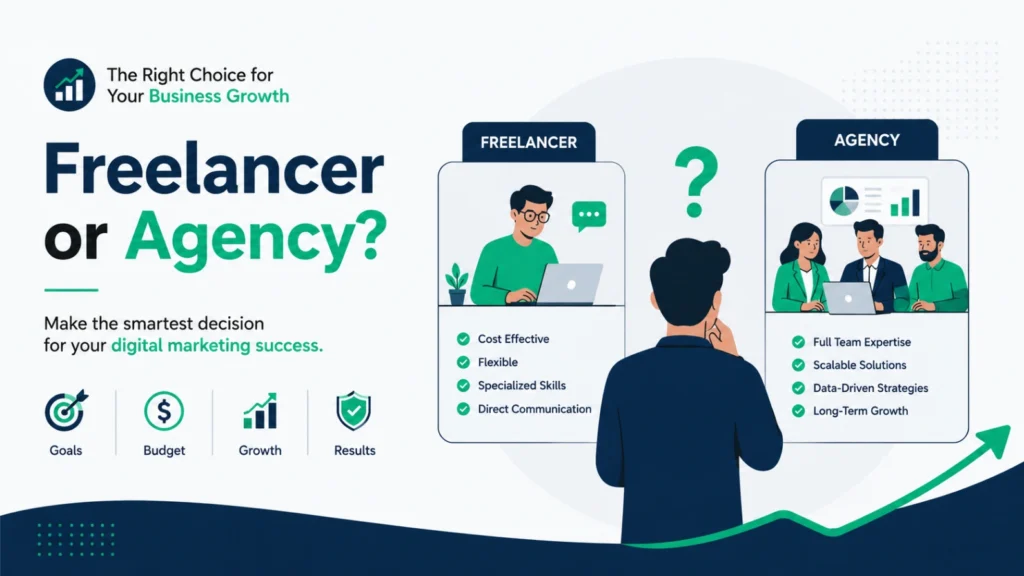
Yes, hiring a digital marketing consultant is worth it in 2027 because digital channels now account for the majority of customer discovery. With AI search, paid ad costs rising, and algorithms changing frequently, businesses need expert guidance to stay visible, competitive, and cost-efficient rather than relying on outdated tactics.
Marketing in 2027 looks very different from even three years ago. Search engines now blend traditional SERP results with AI Overviews, voice search, and conversational AI tools like ChatGPT, Gemini, and Perplexity. Businesses that don’t adapt their SEO and content strategy risk becoming invisible in these new discovery channels. A digital marketing consultant stays updated on these shifts as part of their profession, so businesses don’t have to spend months learning through trial and error.
Consider a mid-sized e-commerce store spending heavily on paid ads with declining returns. A consultant can audit the account, identify wasted spend, and reallocate budget toward higher-performing channels — often recovering the cost of the consultation within a few months. This kind of measurable outcome is why more businesses view consulting not as an expense, but as an investment with a clear return, especially when internal teams lack the bandwidth to test new strategies safely.
Quick Overview: Benefits of Hiring a Digital Marketing Consultant
Below is a quick-reference summary before we explore each benefit in detail:
Benefit | Business Impact |
Expert Strategy | Avoids guesswork, aligns marketing with goals |
Cost Savings | Cheaper than a full in-house marketing team |
Advanced Tools | Access to premium SEO, ad, and analytics platforms |
SEO & Organic Growth | Long-term, sustainable website traffic |
Paid Ad Performance | Lower cost-per-click, higher ROI |
Social Media Growth | Stronger brand visibility and engagement |
Lead Generation | More qualified leads, better conversion rates |
Data-Driven Decisions | Reduced risk, measurable results |
Scalability | Marketing that grows with the business |
Time Savings | Internal teams focus on core operations |
This overview reflects patterns seen consistently across industries — from local service businesses to growing e-commerce brands — making it a reliable snapshot of what to expect from professional consulting.
How We Identified These Benefits.
These benefits were identified by analyzing common patterns across digital marketing case studies, industry reports, and real client outcomes reported by consultants and agencies across sectors like retail, healthcare, real estate, and B2B services.
Rather than listing generic advantages, this list was built by comparing recurring themes: What do businesses consistently struggle with before hiring a consultant? What changes after? Common before-and-after patterns include unclear marketing direction turning into a documented strategy, inconsistent ad spend turning into measurable ROI tracking, and stagnant website traffic turning into steady organic growth through improved SEO practices.
Industry benchmarks were also considered — for instance, businesses that adopt structured, data-driven marketing typically see more predictable growth than those relying on ad-hoc campaigns, a pattern widely recognized in digital marketing case studies and agency reporting. Additionally, common client feedback themes — such as valuing clarity, accountability, and measurable reporting — were factored into ranking these benefits by real-world importance rather than theoretical value.
This method ensures the benefits listed below aren’t just assumptions, but reflect what businesses actually experience when working with a qualified, experienced digital marketing consultant.
What Does a Digital Marketing Consultant Do?
A digital marketing consultant analyzes a business’s current marketing performance, identifies gaps, and creates a strategic plan across SEO, paid advertising, content, email, and social media. They may also implement campaigns directly or guide internal teams on execution and performance tracking.
Their role typically starts with an audit — reviewing website performance, keyword rankings, ad account structure, social media engagement, and conversion tracking. From this audit, they build a prioritized action plan based on what will move the needle fastest. For a service-based business, this might mean fixing local SEO first; for an e-commerce brand, it might mean restructuring Google Ads campaigns to reduce wasted spend.
Beyond strategy, many consultants also stay hands-on — writing content briefs, optimizing landing pages, setting up analytics dashboards, or training internal staff. Unlike a one-size-fits-all approach, a good consultant tailors recommendations to the business’s budget, industry, and growth stage. They also track key performance indicators like organic traffic, cost-per-lead, and conversion rate to prove ROI over time.
In short, a consultant acts as both strategist and advisor — someone who brings clarity to a business’s marketing direction while ensuring every dollar spent is working toward measurable growth. Learn more about [digital marketing strategy planning] to understand how this process typically unfolds.
What Digital Marketing Consultant Services Can Help Your Business Grow?
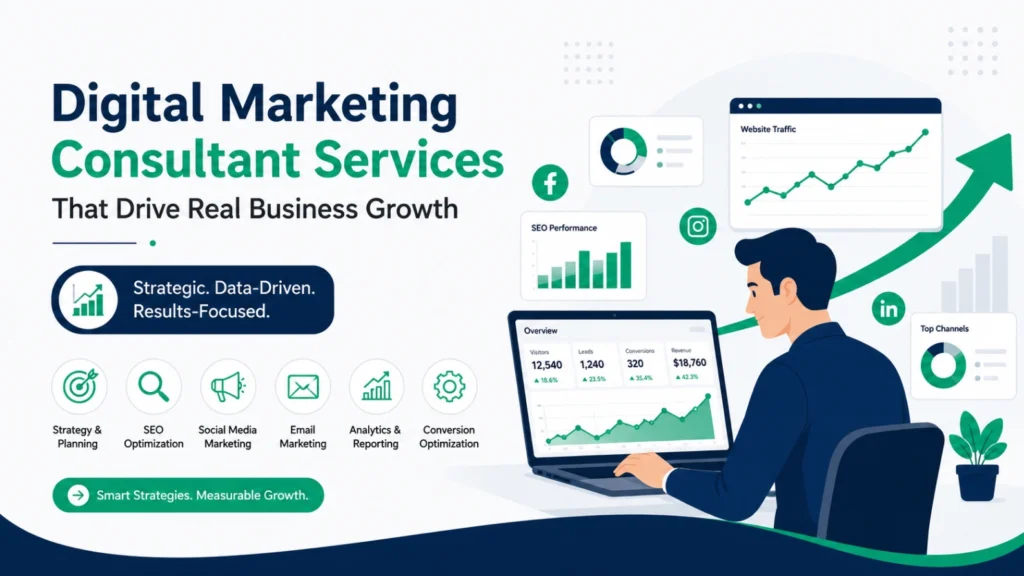
Core digital marketing consultant services include SEO strategy, paid advertising management, content marketing, social media strategy, email marketing, conversion rate optimization, and analytics reporting. These services work together to increase visibility, generate leads, and improve overall marketing ROI.
Each service plays a different role. SEO services focus on long-term organic visibility — helping a business rank for searches its customers are already making. Paid advertising services (Google Ads, Meta Ads, LinkedIn Ads) focus on immediate, measurable traffic and leads. Content marketing supports both, providing the material that fuels SEO rankings and builds trust with potential customers.
Many businesses also benefit from conversion rate optimization (CRO) — a service often overlooked, where a consultant improves website elements like page speed, calls-to-action, and form design to convert more existing traffic into leads or sales, without needing to spend more on ads.
It’s worth understanding the difference between related terms. For example, people often ask what is a digital advertising agency — typically a larger team managing multiple client campaigns — compared to a solo digital marketing consultant, who usually offers more personalized, direct strategic input. Depending on business size and goals, one or the other (or a combination) may deliver better results.
Top 10 Benefits of Hiring a Digital Marketing Consultant.
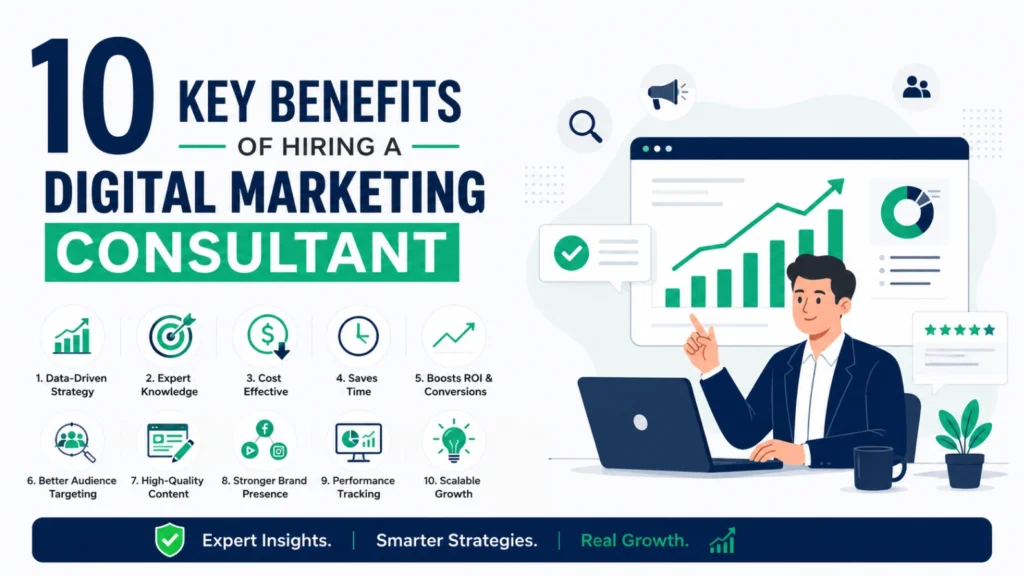
Below are the ten most impactful, research-backed benefits businesses experience when hiring a digital marketing consultant — covering strategy, cost, tools, SEO, ads, social media, conversions, data, scalability, and time savings.
Expert Digital Marketing Strategy
A digital marketing consultant helps businesses avoid costly trial and error by creating proven strategies that deliver faster, more predictable growth. Their expertise ensures your digital marketing services are aligned with your business goals, target audience, and industry.
For example, a B2B company may focus on LinkedIn and content marketing, while a local business may benefit more from local SEO and Google Business Profile optimization. By integrating digital marketing services like SEO, PPC, content, and social media into one strategy, consultants improve efficiency, consistency, and long-term results.
Cost-Effective Marketing Solutions
Hiring a consultant is typically far more cost-effective than building a full in-house marketing team, since businesses pay only for the expertise and hours they need, without added costs like salaries, benefits, or software licenses for multiple full-time employees.
A full in-house team — including an SEO specialist, ad manager, content writer, and strategist — can be a significant ongoing expense for a growing business. A consultant offers a flexible alternative, scaling services up or down based on budget and business needs, without long-term overhead. This is especially valuable for small businesses that need expert-level marketing but can’t yet justify multiple full-time salaries.
Many businesses find that the return generated from optimized ad spend and improved conversions covers the consulting cost within the first few months, making it a financially sound decision rather than just an expense.
Access to Advanced Marketing Tools
Digital marketing consultants typically have access to premium SEO, advertising, and analytics tools that most businesses would otherwise pay for separately — tools that provide deeper insights into keyword opportunities, competitor strategies, and campaign performance.
Tools like enterprise-level SEO platforms, ad intelligence software, and advanced analytics dashboards often come with high monthly costs. A consultant already has access to these tools as part of their business, meaning clients benefit from professional-grade data without paying for multiple subscriptions themselves. This also means faster, more accurate decision-making, since insights are based on real data rather than assumptions.
For example, a consultant using competitor ad intelligence tools can quickly identify which keywords a competitor is bidding on successfully, allowing a business to adjust its own strategy accordingly — a level of insight that’s hard to achieve without the right tools in place.
Better SEO and Organic Growth
A digital marketing consultant improves SEO by identifying technical issues, optimizing on-page content, and building a sustainable content strategy that increases organic search visibility over time, reducing long-term dependence on paid advertising.
SEO is a long-term investment, and small technical issues — like slow page speed, missing meta tags, or poor internal linking — can quietly hold a website back for years. A consultant identifies and fixes these issues while also building a content plan around keywords that match real search intent. This is especially important now, as AI search tools like Google’s AI Overview pull answers directly from well-structured, authoritative content.
Businesses working with an experienced consultant often see steady increases in organic traffic over 3–6 months, as search engines recognize improved site structure, relevant content, and stronger authority signals.
Improved Paid Advertising Performance
A digital marketing consultant improves paid advertising performance by refining audience targeting, ad copy, and bidding strategy — reducing wasted ad spend while increasing click-through rates and conversions from Google Ads, Meta Ads, and other platforms.
Many businesses running ads without expert guidance overspend on broad targeting or underperform due to poor ad copy and weak landing pages. A consultant audits existing campaigns, removes wasted spend from irrelevant keywords or audiences, and restructures campaigns around what’s actually converting. This often results in a lower cost-per-click and a higher return on ad spend within weeks, not months.
For example, restructuring a poorly segmented Google Ads account into tightly themed ad groups with matching landing pages is a common, proven method consultants use to immediately improve Quality Score and reduce cost-per-click.
Stronger Social Media Marketing
A digital marketing consultant strengthens social media marketing by developing a content strategy aligned with business goals, choosing the right platforms for the target audience, and using data to improve engagement and reach instead of posting without direction.
Many businesses post on social media inconsistently, without a clear content plan or performance tracking. A consultant identifies which platforms actually reach the target audience — for instance, LinkedIn for B2B services versus Instagram for lifestyle brands — and builds a content calendar around that. They also analyze engagement data to refine what type of content performs best, whether that’s educational posts, behind-the-scenes content, or customer testimonials.
This structured approach turns social media from a guessing game into a measurable channel that supports brand awareness, trust, and lead generation over time.
Higher Lead Generation and Conversion Rates
A digital marketing consultant increases lead generation and conversion rates by optimizing the entire customer journey — from ad targeting and landing pages to calls-to-action and follow-up sequences — ensuring more website visitors turn into actual leads or customers.
Generating traffic is only half the equation; converting that traffic into leads is where many businesses fall short. A consultant reviews landing page design, form length, page speed, and messaging clarity to remove friction points that cause visitors to leave without converting. Small changes, like simplifying a contact form or clarifying a call-to-action, can noticeably increase conversion rates.
Consultants also often set up lead nurturing sequences, such as automated follow-up emails, ensuring leads that aren’t ready to buy immediately are still guided toward a decision over time, rather than being lost entirely.
Data-Driven Marketing Decisions
A digital marketing consultant uses analytics and performance data to guide every marketing decision, ensuring budget is spent on strategies proven to work rather than assumptions, which reduces risk and improves overall marketing ROI.
Rather than relying on instinct, a consultant sets up proper tracking — through tools like Google Analytics and conversion tracking — to measure what’s actually driving results. This means decisions like increasing ad budget, pausing a campaign, or shifting content strategy are based on real performance data, not guesswork.
For example, if data shows that blog traffic converts better than social media traffic for a particular business, a consultant can shift more resources toward content marketing and SEO, directly improving return on investment. This data-driven approach is a core reason experienced consultants consistently outperform unmanaged, ad-hoc marketing efforts.
Scalable Marketing for Business Growth
A digital marketing consultant builds marketing systems that scale with the business, allowing strategies to expand smoothly as the company grows, rather than requiring a complete rebuild every time revenue or team size increases.
As businesses grow, marketing needs change — a strategy that worked for a small local business may not support expansion into new markets or product lines. A consultant designs scalable systems from the start, such as SEO content frameworks, repeatable ad campaign structures, and automated email workflows, so growth doesn’t require starting from scratch.
This is particularly valuable for businesses planning to expand geographically or launch new products, since a consultant can adjust existing strategies rather than building entirely new ones, saving significant time and cost during growth phases.
Saves Time and Internal Resources
Hiring a digital marketing consultant saves valuable time and internal resources by managing strategy, execution, performance tracking, and SEO services. This allows business owners and teams to focus on core operations while improving online visibility and business growth.
For many small business owners, managing marketing alongside daily operations leads to inconsistent effort and missed opportunities. A consultant takes on the research, testing, and ongoing optimization that marketing requires, delivering expert-level results without consuming internal team bandwidth.
This time savings often has a compounding effect — teams stay focused on their core strengths, whether that’s product development, customer service, or sales, while marketing runs efficiently in the background under expert management.
Common Misconceptions About Digital Marketing Consultants
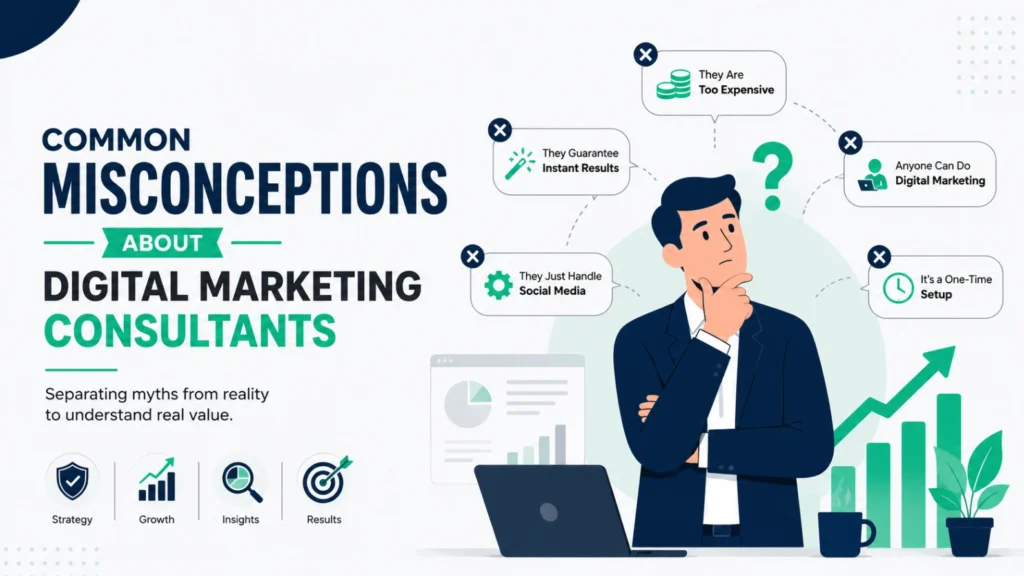
A common misconception is that digital marketing consultants are only for large businesses or that results happen instantly. In reality, consultants work with businesses of all sizes, and sustainable results — especially in SEO — typically take a few months to fully materialize.
Another misconception is confusing what a consultant does versus what freelancer do. Freelancers often execute specific tasks, like writing ad copy or managing a single social media account, while a consultant typically provides broader strategic direction across multiple channels, sometimes overseeing freelancers or internal teams to implement that strategy.
Some businesses also assume hiring a consultant means giving up control over marketing decisions. In practice, good consultants collaborate closely with business owners, explaining the reasoning behind each recommendation rather than making unilateral decisions.
Finally, many assume all consultants offer the same services at the same quality level. In reality, expertise varies significantly, which is why researching experience and past results is essential before hiring — a topic covered in the next section on choosing the right consultant.
How to Choose the Right Digital Marketing Consultant
Choose a digital marketing consultant by reviewing their case studies, checking client testimonials, confirming their expertise matches your specific needs (SEO, ads, or social media), and ensuring they offer clear, measurable reporting rather than vague promises.
Start by asking for examples of past results relevant to your industry or business size. A consultant experienced with e-commerce brands may not be the best fit for a B2B service business, and vice versa. Request specific metrics — such as organic traffic growth, cost-per-lead reduction, or conversion rate improvements — rather than general claims of success.
It’s also important to evaluate communication style and reporting structure upfront. The best digital marketing consultant for your business will provide regular, understandable performance updates rather than technical jargon without context. Ask how often you’ll receive reports and what key metrics will be tracked.
Finally, consider starting with a smaller project or short-term engagement before committing to a long-term contract. This allows both parties to confirm fit, communication style, and results before scaling the relationship into a larger, ongoing partnership.
Red Flags to Avoid Before Hiring a Digital Marketing Consultant
Red flags include guaranteed rankings or results, no clear reporting process, reluctance to share past client results, pressure to sign long-term contracts immediately, and vague explanations of strategy without measurable goals.
No ethical consultant can guarantee a #1 Google ranking or a specific number of leads, since search engines and ad platforms are influenced by many factors outside anyone’s full control. Claims like this are a major warning sign of inexperience or dishonesty.
Similarly, be cautious of consultants who avoid discussing specific metrics or refuse to explain their strategy in understandable terms. Transparency is a hallmark of trustworthy digital marketing consultation services — if a consultant can’t clearly explain what they’re doing and why, it’s difficult to hold them accountable for results.
Lastly, watch for consultants pushing immediate long-term contracts without first understanding your business goals. A thoughtful consultant typically starts with an audit or short discovery phase before recommending a long-term strategy, ensuring the partnership is built on a clear, mutual understanding of expectations.
Why Digital Marketing Consultants Are More Important Than Ever in 2027
Digital marketing consultants are more important than ever in 2027 because search behavior has shifted toward AI-driven platforms, rising ad costs demand smarter budget allocation, and algorithm changes now happen more frequently, making expert guidance essential for staying visible and competitive.
Search is no longer limited to traditional Google results. Consumers increasingly use AI tools like ChatGPT, Gemini, and Perplexity to research products and services, meaning businesses must structure their content to be easily understood and cited by AI systems, not just ranked by traditional SEO. This requires expertise most internal teams haven’t yet developed.
At the same time, rising costs across paid advertising platforms mean inefficient campaigns are more costly than ever. A consultant’s ability to eliminate wasted spend and improve targeting has a direct, measurable impact on profitability.
Combined, these shifts mean businesses relying on outdated or unmanaged marketing strategies risk falling behind competitors who are actively adapting — making experienced guidance not just helpful, but increasingly necessary for sustainable growth.
Future of Digital Marketing Consulting
The future of digital marketing consulting will focus heavily on AI-assisted strategy, personalized customer journeys, and optimizing content for both traditional search engines and AI-driven platforms, as businesses increasingly compete for visibility across multiple discovery channels at once.
Consultants are increasingly expected to understand not just SEO and paid ads, but also how AI search engines interpret and cite content, making structured, clear, and authoritative content more valuable than ever. This shift favors consultants who combine traditional digital marketing expertise with a strong understanding of emerging AI search behavior.
Automation will also continue to play a larger role, with consultants using AI tools to speed up research, reporting, and campaign optimization — allowing them to focus more time on strategy and business-specific decision-making rather than repetitive manual tasks.
Ultimately, businesses that partner with forward-thinking consultants — ones who adapt to these changes rather than relying solely on outdated tactics — will be better positioned to maintain visibility, build trust, and sustain growth as digital marketing continues to evolve through 2027 and beyond.
Frequently Asked Questions (FAQs)
A digital marketing consultant helps businesses improve their online presence by creating marketing strategies, optimizing SEO, managing paid ads, improving social media performance, generating leads, and increasing sales. They provide expert guidance based on your business goals.
Yes. Hiring a digital marketing consultant is worth it because they bring expertise, save time, reduce costly marketing mistakes, and help improve your return on investment (ROI). They also create data-driven strategies that support long-term business growth.
Some of the biggest benefits include expert marketing advice, better SEO performance, improved lead generation, cost-effective marketing, higher conversion rates, access to advanced tools, and strategies that help your business grow faster.
A digital marketing consultant provides personalized strategy and expert guidance, while a digital marketing agency usually has a team that manages multiple marketing services. Consultants are often more flexible and cost-effective for small and growing businesses.
You should hire a digital marketing consultant if your website traffic is declining, your marketing campaigns are not delivering results, you’re launching a new business, or you need expert guidance to increase leads, sales, and online visibility.
Choose a consultant with relevant experience, proven results, client testimonials, industry knowledge, transparent communication, and expertise in services like SEO, PPC, social media marketing, and content marketing.
Yes. A digital marketing consultant can help small businesses create affordable marketing strategies, improve local SEO, generate qualified leads, build brand awareness, and compete more effectively without the cost of hiring a full in-house marketing team.